Your new dentist is ready to see patients. But is your practice ready for insurance network participation?
A dental practice may have everything prepared for a new provider, from treatment rooms and patient appointments to scheduling and billing systems. Yet one incomplete application or overlooked credentialing requirement can delay the provider’s participation in an insurance network.
These delays can create uncertainty around patient benefits, insurance claims, and reimbursement. For practices expanding their teams or adding new locations, the administrative burden can quickly grow.
The challenge is that many dental credentialing mistakes are preventable. They often begin with small documentation errors, outdated provider information, or missed communication with insurance payers.
Understanding where the process commonly goes wrong can help your dental practice avoid unnecessary setbacks.
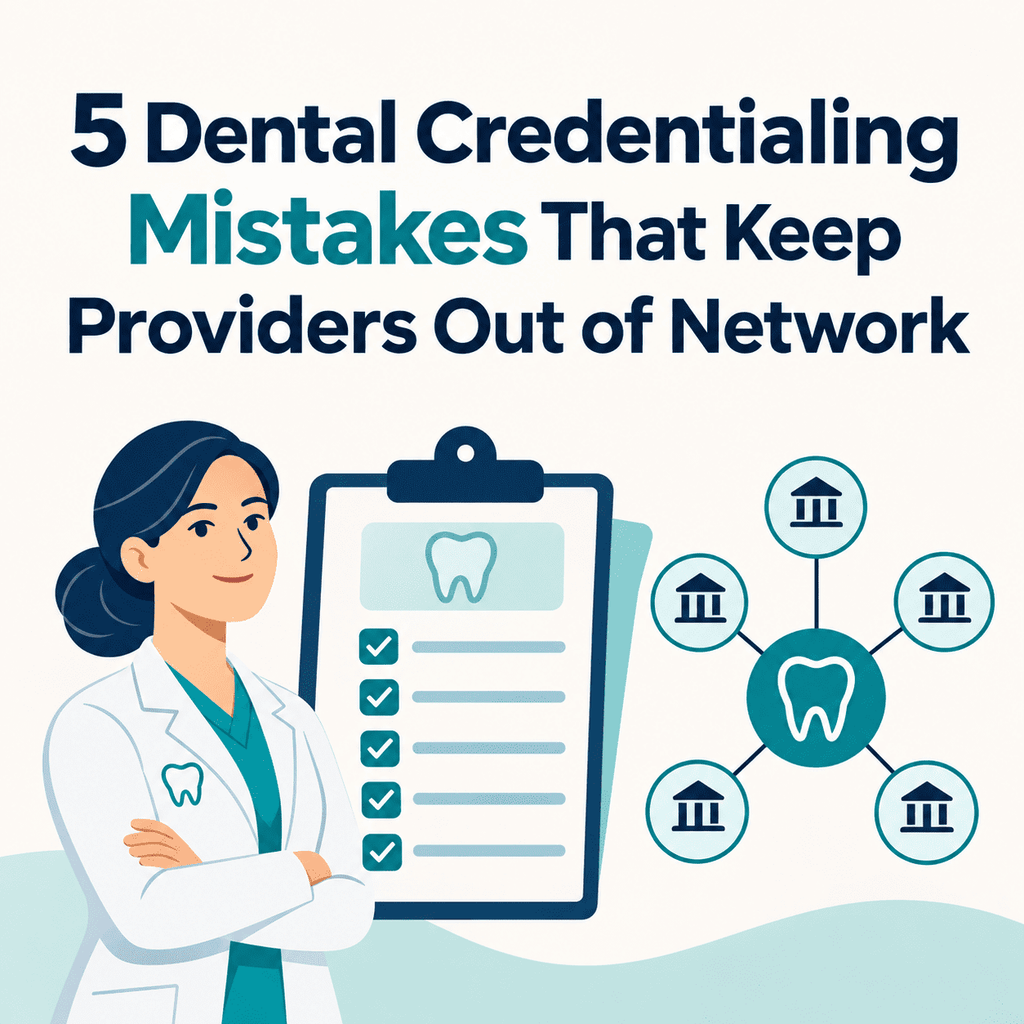
Here are five credentialing mistakes worth addressing before they affect your provider enrollment process.
Why Dental Credentialing Matters for Your Practice
Dental credentialing is the process insurance companies use to verify a dentist’s professional qualifications, including licensing, education, work history, and other required documentation.
It is an important part of establishing eligibility for participation in insurance networks.
However, credentialing is not always the final step. Payer contracting, provider enrollment, and confirmation of network effective dates may also be necessary.
When these activities are poorly coordinated, practices can face:
- Delays in insurance network participation
- Additional administrative work for office teams
- Uncertainty about a new provider’s network status
- Potential reimbursement complications
- Difficulties planning provider onboarding
A more organized approach to dental insurance credentialing helps practices manage these challenges before they become larger operational problems.
1. Incomplete Provider Information: Small Errors That Delay Approval
One of the most common dental credentialing mistakes is submitting applications with incomplete or inconsistent provider information.
An incorrect National Provider Identifier (NPI), mismatched practice address, missing employment history, or outdated professional document may appear minor. However, insurance payers rely on accurate information to verify a provider’s credentials.
When details do not match, the payer may request corrections or additional documentation.
Where practices commonly go wrong
- Entering incorrect NPI or provider details
- Using inconsistent names across documents
- Submitting outdated licenses or insurance records
- Leaving required application fields incomplete
- Providing incorrect practice or billing information
How to avoid this mistake
Before submitting an application, compare provider details against official records and supporting documents.
Create a standardized credentialing checklist covering identification, licensing, professional history, practice information, and payer-specific documentation.
Quick tip: Maintain a verified provider information file so your team can prepare future applications without repeatedly collecting the same information.
2. Outdated CAQH Profiles: The Credentialing Problem Practices Overlook
A provider’s credentialing profile can become outdated even when the original application was completed correctly.
CAQH, which transitioned to the DataSpring branding in 2026, provides a centralized platform through which participating organizations can access provider information.
However, maintaining an accurate profile requires ongoing attention.
Changes in practice location, professional liability coverage, contact information, or required attestations may need to be reflected in the provider’s profile.
Why outdated information creates problems
If an insurance payer cannot access complete and current information, it may need to request additional documentation before continuing its review.
This can create unnecessary communication and slow down an otherwise straightforward application.
How to avoid this mistake
- Review provider profiles regularly.
- Update practice addresses and contact information.
- Replace expired supporting documents.
- Confirm that appropriate payers have access.
- Complete required profile re-attestations.
CAQH generally requires practitioner re-attestation every 120 days, subject to applicable exceptions and current platform requirements.
Quick tip: Add profile maintenance and attestation reminders to your practice’s credentialing calendar.
3. Ignoring Payer-Specific Requirements: Why One Application Doesn’t Fit All
Not every dental insurance company follows the same credentialing and enrollment process.
Although many payers request similar provider details, their application procedures, supporting documentation, network availability, and contracting requirements may differ.
A practice that relies on one standard process for every payer can overlook important steps.
The problem with a one-size-fits-all approach
Imagine submitting applications to several insurance networks using the same documentation package.
One payer may accept the information, while another requires additional forms, separate contracting documents, or a different enrollment procedure.
Without checking these requirements in advance, the practice may discover missing steps only after submission.
How to avoid this mistake
Before beginning an application:
- Confirm that the payer is accepting providers into the desired network.
- Review its current credentialing requirements.
- Identify required forms and supporting documents.
- Verify submission procedures.
- Understand the payer’s contracting and enrollment steps.
- Record how application status can be checked.
Quick tip: Create a separate credentialing checklist for each insurance payer your practice works with.
4. Confusing Credentialing Approval With Active Network Participation
A dentist may complete credentialing without immediately becoming an active in-network provider.
This distinction is important because credentialing, contracting, and provider enrollment are related but separate activities.
Credentialing verifies a provider’s professional qualifications.
Contracting establishes the terms of participation between the provider or practice and the insurance payer.
Provider enrollment involves completing the administrative requirements for participation and claims processing.
The network effective date establishes when the provider’s participation begins under the applicable payer agreement.
Why this mistake can affect your practice
Suppose your office receives confirmation that a newly hired dentist has completed credentialing.
The scheduling team begins telling patients that the dentist is in-network.
However, the payer has not yet confirmed the provider’s active participation or effective date.
This misunderstanding can create incorrect patient expectations and potential reimbursement complications.
How to avoid this mistake
Request written confirmation of network participation and the applicable effective date.
Verify the provider’s details, tax identification information, practice location, and insurance network before communicating in-network status to patients.
Quick tip: Never assume that submitting an application or receiving credentialing approval automatically establishes active network participation.
5. Poor Application Follow-Up: When Pending Credentialing Turns Into Delays
Submitting a credentialing application does not mean the remaining process will happen without further action.
Insurance payers may request clarification, updated documents, signatures, or additional enrollment information.
When these requests are not monitored, an application may remain pending longer than necessary.
How applications lose momentum
A dental practice submits several provider applications and assumes that each payer will respond when the review is complete.
Later, the team discovers that one payer requested a corrected document while another is waiting for a signed agreement.
Without a consistent follow-up process, these unresolved requests can create avoidable delays.
How to avoid this mistake
Maintain a credentialing tracker that includes:
- Insurance payer and network name
- Provider and practice location
- Application submission date
- Current application status
- Outstanding documentation
- Last communication date
- Next follow-up action
- Confirmed network effective date
Assign responsibility for monitoring each pending application and follow the payer’s recommended communication procedures.
Quick tip: Every pending application should have a documented next action, even when the team is waiting for a payer response.
Dental Credentialing Checklist Before You Submit
Preventing common credentialing mistakes begins with a consistent review process.
Use this checklist before submitting a new provider application.
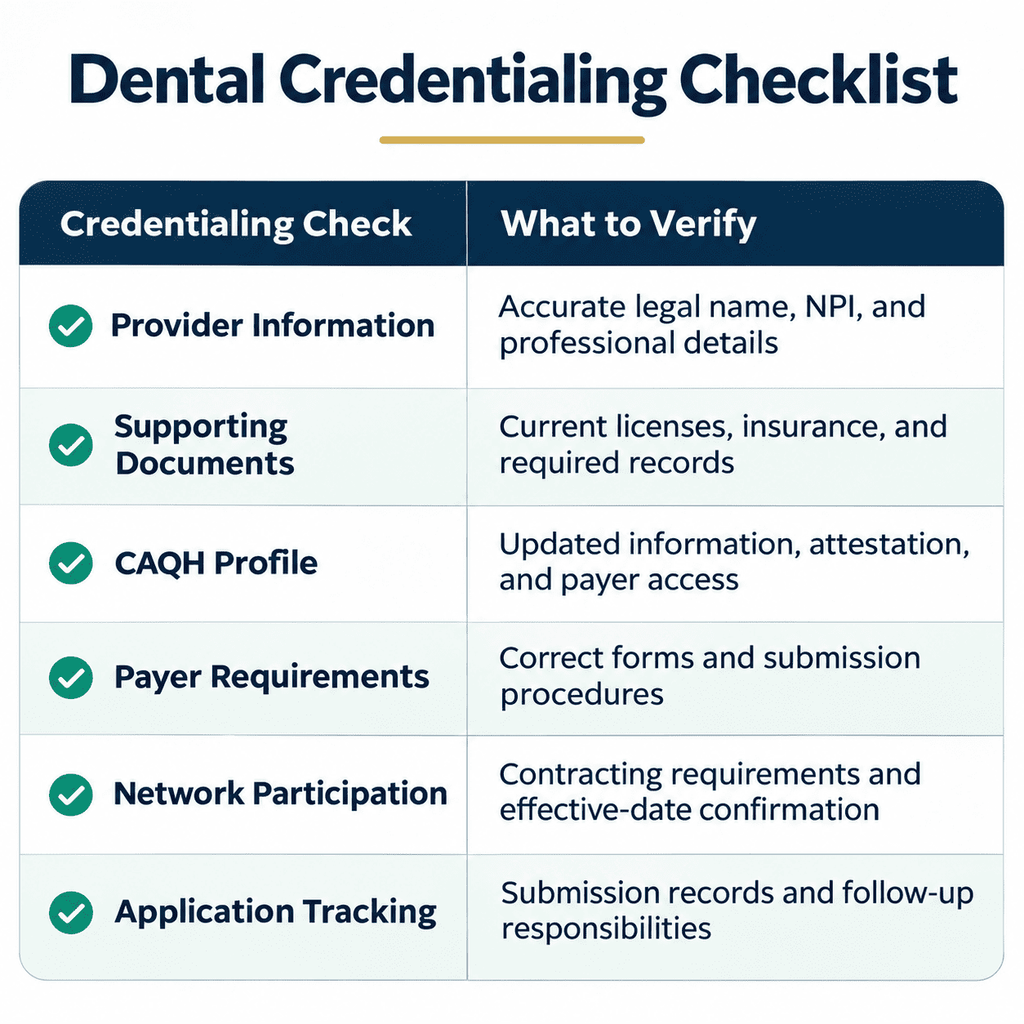
A standardized checklist can help dental practices identify missing information earlier and improve visibility throughout the enrollment process.
How Dental Credentialing Services Can Help Prevent These Mistakes
Managing dental credentialing internally can become challenging when office staff are already responsible for scheduling, insurance verification, billing, and patient communication.
The workload may increase further when practices hire additional dentists or manage multiple insurance networks.
Professional dental credentialing services can help practices organize provider information, prepare applications, monitor payer responses, and maintain clearer enrollment records.
This support may help practices:
- Reduce preventable documentation errors
- Improve visibility into application status
- Coordinate new-provider onboarding
- Maintain more consistent payer follow-ups
- Reduce routine administrative demands on office staff
While no credentialing service can guarantee payer approval or eliminate every delay, an organized process can help practices manage the steps within their control.
Simplify Dental Credentialing With DentDesk Billing Solutions
Your dental practice should not have to spend unnecessary time correcting preventable credentialing errors or searching for updates on pending applications.
At DentDesk Billing Solutions, we provide dental credentialing and provider enrollment support to help practices manage application preparation, documentation, and payer follow-ups.
Whether you are onboarding a new dentist, expanding your practice, or looking for a more organized enrollment process, our team can help you manage the administrative details.
Ready to make dental credentialing more manageable?
Explore our Dental Credentialing Services and discover how DentDesk can support your practice.
Frequently Asked Questions About Dental Credentialing Mistakes

1. What are the most common dental credentialing mistakes?
Common mistakes include submitting incomplete provider information, maintaining outdated CAQH profiles, overlooking payer-specific requirements, confusing credentialing approval with network participation, and failing to follow up on pending applications.
2. How can dental credentialing mistakes affect insurance reimbursement?
Credentialing and enrollment problems may affect a payer’s recognition of a provider’s network status and the way claims are processed. The outcome depends on the payer’s requirements, the provider’s participation status, and applicable contract terms.
3. How long does dental insurance credentialing take?
Dental credentialing timelines vary depending on the insurance payer, application completeness, network requirements, and contracting procedures. Practices should request current processing estimates directly from each payer and begin preparations early.
4. What is the difference between dental credentialing and provider enrollment?
Dental credentialing involves verifying a dentist’s professional qualifications. Provider enrollment involves registering the dentist with an insurance payer and completing applicable administrative requirements. Contracting and network activation may require additional steps.
5. Can outsourcing dental credentialing services help reduce errors?
Outsourcing can provide structured application preparation, documentation management, and payer follow-up support. It may reduce avoidable administrative errors, although approval decisions and processing timelines remain subject to payer requirements.
Final Thoughts
Dental credentialing mistakes may start with something as simple as an outdated document or an unanswered payer request, but their effects can extend into provider onboarding, patient communication, and revenue cycle operations.
The best approach is to verify provider information, understand individual payer requirements, maintain accurate profiles, and monitor applications consistently.
With an organized credentialing process, dental practices can reduce preventable setbacks and prepare more confidently for insurance network participation.
Need support with dental credentialing and provider enrollment?
Contact DentDesk Billing Solutions to discuss your practice’s credentialing needs.

No responses yet